
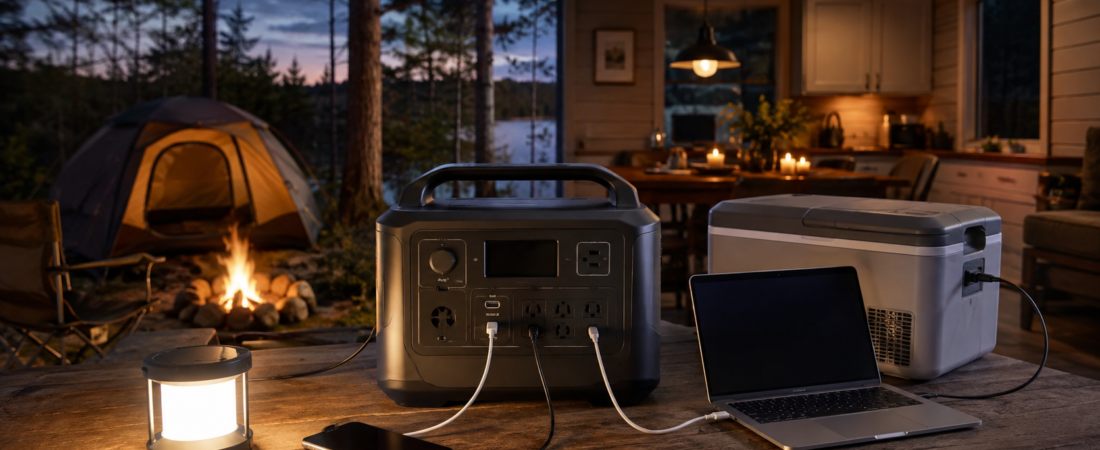
A portable power station should be sized from the devices you actually plan to run—not the largest number printed on the most heroic-looking box. Enter each device below to estimate daily energy, battery capacity and inverter output.
Portable Power Station Size Calculator
Estimate watt-hours and inverter output for camping or short home-backup use.
| Device | Watts | Hours/day | Quantity | Wh/day |
|---|---|---|---|---|
| 0 | ||||
| 0 | ||||
| 0 | ||||
| 0 | ||||
| 0 | ||||
| 0 |
Recommended minimum specifications
This is a planning estimate, not an electrical certification. Verify voltage, connector, charger, inverter waveform, surge requirements and manufacturer limits for every device. Never operate a fuel-burning generator indoors.
How to use the result
Round up to a commonly available capacity rather than buying exactly the calculated number. The estimate already includes the loss, cold-weather and reserve allowances you selected, but real runtime still changes with temperature, battery age and inverter efficiency.
Continuous watts and surge watts are different
Battery capacity tells you roughly how long equipment can run. Inverter output determines whether the power station can start and operate it at all. Refrigerators, pumps and some tools may briefly demand much more power at startup than their ordinary running wattage.
Check these details before buying
- Usable battery capacity rather than marketing capacity alone
- Continuous and surge inverter output
- Pure-sine-wave requirements for sensitive equipment
- Solar and vehicle-recharge limits
- Low-temperature charging restrictions
- Canadian warranty service and replacement-battery availability
For worked examples and a printable version, use the NorthScout portable power-station sizing guide.