
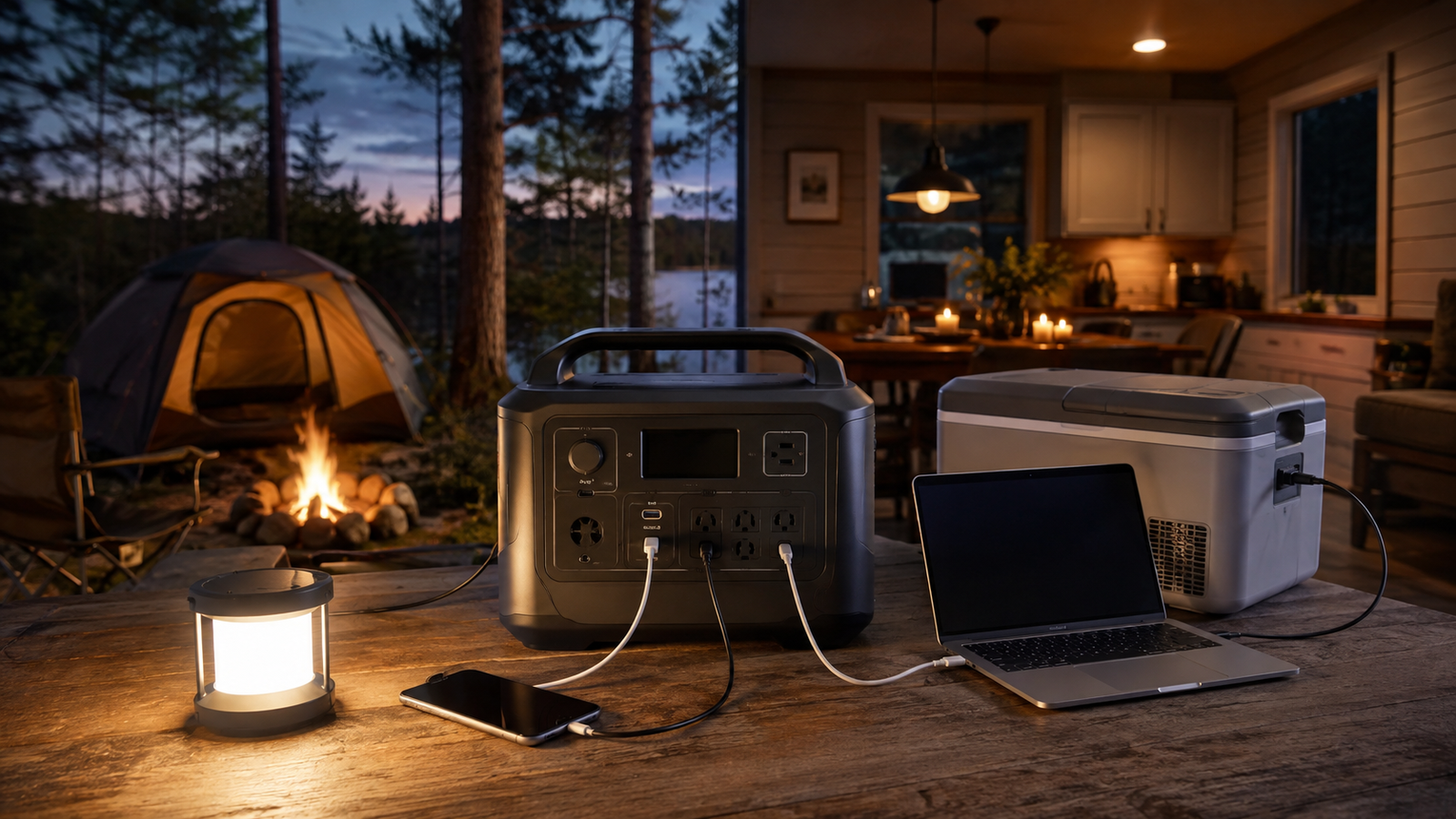
Shopping for a power station gets confusing fast because the biggest number on the box is rarely the whole story. A 2000-watt model is not automatically twice as useful as a 1000-watt model. The inverter rating tells you what it can power at one time; the battery capacity tells you how long it can keep going. You need both numbers to make a sensible choice.
The short answer
A 1000W inverter is often enough for electronics, lights, communications, CPAP equipment and some refrigeration loads. A 2000W inverter can support more high-draw appliances, but only when its surge rating, battery capacity and outlet limits also meet the load.
Check each appliance nameplate. Do not choose from category averages alone.
Watts and watt-hours are not interchangeable
- Watts (W): how much power an appliance needs at a moment in time.
- Watt-hours (Wh): how much stored energy the battery contains.
- Surge watts: short-duration power required when motors or compressors start.
For example, a station might have a 2000W inverter paired with a 1000Wh battery. It can probably start a 1500W appliance, but it will not run it for long. Big engine, small fuel tank.
The basic runtime calculation
Estimated runtime = usable battery watt-hours ÷ appliance watts.
Allow for inverter losses, idle draw, cold weather and reserve capacity. NorthScout’s calculator applies a planning allowance instead of pretending every advertised watt-hour reaches the appliance.
Calculate capacity and inverter needs →
Where a 1000W power station fits
When the appliance nameplate and startup surge fit within the station limits, a 1000W-class inverter may be suitable for:
- Phones, tablets, laptops and camera batteries
- LED lighting and communications equipment
- CPAP equipment, subject to the medical-device manufacturer’s requirements
- Televisions and internet equipment
- Some refrigerators, freezers and coolers with acceptable startup surge
- Small chargers and lower-power tools
It may not reliably handle kettles, large microwaves, space heaters, hair dryers, hot plates or multiple substantial loads at once. The actual nameplate rating decides.
Where a 2000W power station earns its size
A 2000W-class inverter provides more room for:
- Many household microwaves
- Some kettles, coffee makers and cooking appliances
- Larger tools
- Multiple moderate loads operating together
- Refrigeration plus lighting and electronics during an outage
There is an important catch: “can run it” is not the same as “can run it for long.” A 1500W appliance can chew through a modest battery in a hurry. Hydro-Québec’s examples show how quickly high-wattage cooking appliances use energy; a kettle may draw roughly 1500W, although the actual rating varies by appliance.
Startup surge changes the decision
Refrigerators, freezers, pumps and power tools can require more power during startup than during normal operation. Compare the appliance’s surge requirement with the station’s surge rating and duration. A vague “peak watts” claim is not enough if the manufacturer does not explain how long that peak is available.
A side-by-side reality check
| Use case | 1000W class | 2000W class |
|---|---|---|
| Phones, lights and laptops | Usually ample | Ample, but may be unnecessary |
| CPAP overnight | Often suitable if capacity is adequate | Suitable, but size from watt-hours |
| Fridge or freezer | Check startup surge carefully | More inverter headroom |
| Microwave or kettle | Often too close to or above the limit | May work; verify nameplate and runtime |
| Several appliances together | Easy to overload | More flexibility |
| Electric space heating | Poor battery use | Still drains batteries quickly |
When 1000W is the smarter purchase
- Your loads are mostly electronics, lights and medical or communications equipment
- Portability matters more than running cooking appliances
- You have measured the loads and confirmed startup surge
- You prefer a smaller battery you can recharge more easily from solar
When 2000W makes sense
- You need to run a microwave, kettle, coffee maker or larger tool
- You expect several loads to overlap
- Your fridge or pump has a demanding startup surge
- The battery capacity is also large enough for the intended runtime
Home-backup safety
Do not connect a portable power source to household wiring by plugging it into a wall outlet. The Government of Canada advises that connection to a home electrical system requires an approved transfer panel and switch installed by a qualified electrician. During an outage, direct connection of suitable appliances to the power station is the simpler approach.
Fuel-powered generators create carbon monoxide and must remain outdoors at least six metres from buildings with exhaust directed away from openings. Battery power stations do not create combustion exhaust at the point of use, but still require ventilation and manufacturer-approved operation.
Choose from your measured loads
Add the watts of everything that may operate together, check startup surge, then calculate the battery capacity required for the desired hours.
Compare our current Canadian portable power picks →
Affiliate disclosure: NorthScout may earn a commission from qualifying purchases at no additional cost to you.
Related NorthScout guides
- Portable power station size calculator
- How to size a portable power station
- Portable power station vs generator in Canada
- Power and solar guide hub
Sources and safety references
- Hydro-Québec small-appliance electricity calculator
- Government of Canada: preparing for power outages
- Health Canada: generator and carbon-monoxide safety
This guide provides planning information. Confirm appliance ratings and follow the power-station and appliance manufacturer instructions.